AI SEO Is Not a Replacement for Traditional SEO. It Is the Layer on Top That Most Businesses Are Missing.

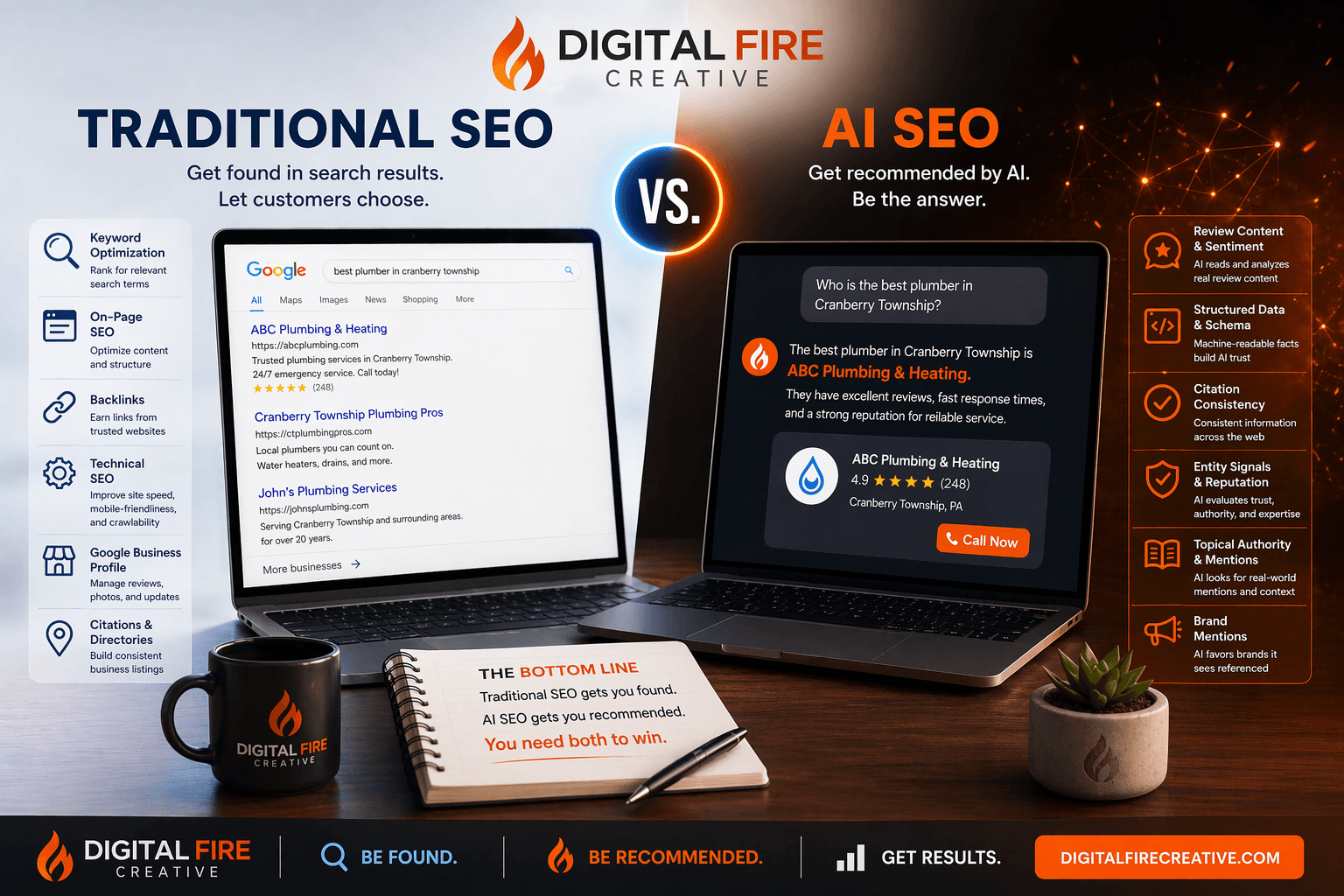
If your business ranks on the first page of Google, you might assume you are covered. Your SEO is working. Customers can find you. What else is there?
More than most business owners realize.
Over the past two years, the way people search for local businesses has changed in a way that traditional SEO was never designed to handle. Tools like ChatGPT, Perplexity, and Google AI Overviews are now answering questions directly. Instead of showing a list of ten blue links and letting the user decide, these tools make a recommendation. They pick a business and tell the user to call them.
If your business is not one of the businesses AI tools recommend, you are invisible to a growing segment of your potential customers. And here is the part that catches most business owners off guard: ranking on Google does not guarantee that AI tools will recommend you. The two systems evaluate businesses differently. The signals that earn you a first-page ranking are not the same signals that earn you an AI recommendation.
This is not a reason to abandon your traditional SEO investment. It is a reason to add a layer on top of it.
What Traditional SEO Actually Does
Traditional SEO is the practice of optimizing your website and online presence so that Google's algorithm ranks your pages higher in search results. It has been the foundation of digital marketing for more than two decades, and it still matters enormously.
The core signals traditional SEO depends on include domain authority, on-page optimization, technical performance, your Google Business Profile, and local citations across directories like Yelp and Angi.
When all of these signals are strong, Google rewards you with higher rankings. Customers searching for an HVAC contractor in Cranberry Township or a dentist in Wexford see your business near the top of the results page. They click through, read your site, and decide whether to call.
That is how traditional search works. The user types a query. Google returns a list. The user chooses.
Traditional SEO is designed for that model. And for businesses in Pittsburgh North and across the country, it still drives real traffic and real leads. But the model is changing.
How AI Search Works Differently
When someone opens ChatGPT and types "who is the best plumber in McCandless" or asks Google AI Overviews "what HVAC company do people recommend in Cranberry Township," they are not getting a list of ten options. They are getting a recommendation. One business, maybe two or three, presented as the answer.
The AI tool has already done the evaluation. It has already decided who to trust. By the time the user sees the response, the competition is over.
"Traditional SEO gets you in front of people who are searching. AI SEO gets you recommended to people who are asking. Those are two completely different conversations."
— Eric Downing, author of The Business Owner's Guide to AI SEO
The signals AI search engines use to make those recommendations overlap with traditional SEO signals in some areas, but they diverge significantly in others. Here is where AI search evaluates differently:
Review content, not just review count. Traditional SEO cares primarily about the number and recency of your Google reviews. AI engines read the actual text of your reviews. They extract specific service descriptions, location references, and sentiment signals. A business with 200 generic five-star reviews may score lower in AI results than a business with 80 detailed, specific reviews that mention the technician by name, describe the work performed, and reference the neighborhood.
Structured data and schema markup. AI engines rely on structured data far more heavily than traditional search because it gives them machine-readable facts without requiring them to interpret unstructured text. If your site does not have proper schema markup identifying your business type, service area, hours, and credentials, AI tools may simply move on to a competitor who made it easier.
Citation consistency across the web. AI engines are particularly sensitive to contradictions. If your Google Business Profile says one address and your Yelp listing says another, traditional SEO may absorb that discrepancy without significant penalty. AI tools treat inconsistency as a negative trust signal. They are designed to recommend businesses that authoritative sources agree on.
Content that answers specific questions. Traditional SEO rewards keyword density and topical relevance. AI engines reward content that directly answers the questions people are asking. A service page that says "we provide HVAC services in Cranberry Township" is useful for traditional SEO. A page that answers "how much does furnace repair cost in Cranberry Township" is useful for AI search.
Entity recognition. AI engines are trying to understand not just whether your website exists, but whether your business exists as a recognized entity in the real world. They look for your business name appearing consistently across news articles, association memberships, community mentions, and authoritative directories.
Why You Need Both, and Why the Order Matters
Traditional SEO is the foundation. AI SEO is the layer on top. You cannot skip the foundation and expect the layer to hold.
Traditional SEO builds the building. It establishes that your business exists, that your website is credible, that your domain has authority, and that Google can crawl and index your pages. Without that foundation, AI engines have very little to work with.
But a business with a solid traditional SEO foundation that has not added the AI layer is like a building with no listing in the directory at the front door. The building exists. It is well constructed. But if someone asks the concierge who to call for a plumber in McCandless, your name never comes up.
AI SEO adds your name to that directory. It optimizes the signals AI engines use to make recommendations. It structures your data so machines can read it. It builds your review content so AI tools can extract and verify what you do.
For businesses in Cranberry Township, Wexford, Mars, Hampton Township, Allison Park, and across Pittsburgh North, this distinction is becoming more important every month. The businesses that figure this out now are building an advantage that will compound over time.
What This Looks Like in Practice
A real estate agent in Wexford might rank on the first page of Google for "real estate agent Wexford PA." That is a meaningful achievement that required real work and real time.
But when a potential buyer asks ChatGPT "who are the best real estate agents in Wexford Pennsylvania," that first-page ranking may not be enough. ChatGPT is not reading Google's rankings. It is pulling from a different set of signals, and if the agent has not optimized for those signals, another agent who ranks lower on Google could be the one who gets recommended.
The same dynamic plays out for HVAC contractors in Cranberry Township, dentists in McCandless, restaurants in Allison Park, and every other local business category across Pittsburgh North.
The Practical Steps That Separate AI-Visible Businesses from Everyone Else
The categories of work that determine whether an AI engine recommends your business include review strategy, schema markup implementation, Google Business Profile optimization, directory and citation consistency, content that answers specific questions, and entity building through community presence and brand mentions.
None of these steps replaces your traditional SEO work. They layer on top of it. A business with strong domain authority, a well-optimized website, and solid traditional SEO fundamentals will see AI SEO efforts compound more quickly than a business starting from zero.
Where to Start
The first step for any business owner in Pittsburgh North who wants to understand where they stand is to get an honest assessment of their current AI visibility. Not a general SEO audit, but a specific evaluation of how AI engines currently perceive and evaluate their business.
Digital Fire Creative offers a free AI visibility check at digitalfirecreative.com/gseo-check. It takes about two minutes and gives you a real score with specific findings. You will see exactly where your business stands, what signals are working in your favor, and where the gaps are that may be costing you AI recommendations right now.
If you want to go deeper, The Business Owner's Guide to AI SEO by Eric Downing covers every layer of AI search optimization in plain language, with practical steps any business owner can understand. Available now on Amazon in Kindle and print at amazon.com/author/ericdowning.
The businesses showing up in AI recommendations today started optimizing for this months ago. The businesses that start today will be the ones showing up months from now.
Keep Reading
More articles

5 Things Real Estate Agents in Cranberry Township and Wexford Can Do This Week to Show Up in AI Search
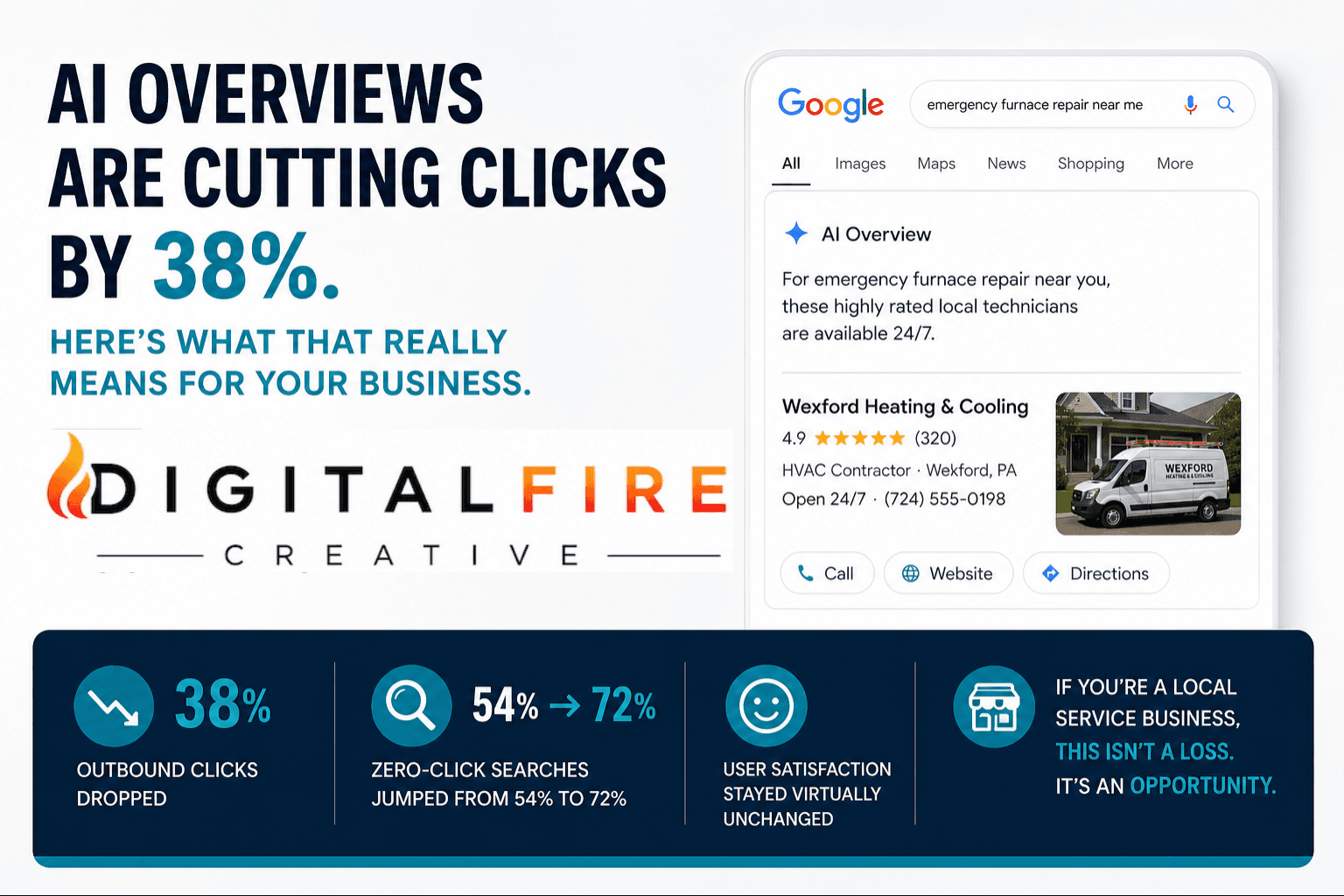
Why the 38% Drop in Google Clicks Is Good News for Local Service Businesses

Why Pittsburgh Businesses Should Choose an AI SEO Agency Over a Traditional SEO Company
Free Check
See how your business ranks in AI search
Get a free GEO report in 60 seconds, no card, no obligation. We will show you exactly where you stand and what your biggest opportunities are.
Get Your Free AI SEO Report →