Your Website and Your Directory Listings Both Feed AI Search. Most Businesses Are Only Managing One.


There's a common assumption I run into with local business owners. They figure that if they have a solid website, they're covered for AI search. Or they've been diligent about keeping their Yelp profile current and assume that's doing the work. The reality is that AI engines draw from both sources at the same time, and when one contradicts or undermines the other, the recommendation you're hoping for often doesn't come through.
Understanding how these two sources interact is one of the more useful things a business owner can know right now, because it changes where you put your energy.
How AI Engines Actually Gather Information About Your Business
When ChatGPT or Perplexity forms a recommendation for a local business, it isn't pulling from one source. It's synthesizing information from across the web, and two categories of sources carry the most weight for local businesses: your own website and the network of third-party directories where your business is listed.
Your website is where AI engines look for authoritative, structured information directly from you. What you do, where you operate, who you serve, how you describe your services. If your website has schema markup, FAQ sections, and clear location-specific content, that information is relatively easy for an AI to extract and trust. If it doesn't, the AI has to work harder and often draws less confident conclusions.
Third-party directories are where AI engines look for corroboration. Yelp, Angi, BBB, Nextdoor, Google Business Profile, TripAdvisor, Houzz, and dozens of category-specific listing sites collectively form a picture of your business that exists independently of what you say about yourself. Reviews from real customers. Business information submitted to multiple platforms. Verified addresses and phone numbers. This is the web's way of checking your work, and AI engines take it seriously.
ChatGPT has been explicit about this in its own outputs. When asked how it identifies local businesses, it has stated that it draws from Yelp, Angi, BBB, and similar sources when forming local recommendations. That's not speculation. It's the model describing its own behavior.
Why Directories Matter More Now Than They Did Three Years Ago
A few years ago, the main reason to care about directory listings was Google's map pack. Having consistent NAP information (name, address, phone number) across Yelp and Google helped you rank in local map results. If you weren't focused on local SEO specifically, you could largely ignore it without losing much.
That changed when AI engines became the starting point for local searches. The reason is simple: AI engines don't have the luxury of ranking a list of ten results and letting users sort it out. They have to commit to a recommendation. To do that confidently, they look for business information that's consistent, verified, and corroborated across multiple independent sources. A listing on Yelp doesn't just tell AI you exist. It tells AI that a third party has verified your name, your location, and your category, and that real customers have interacted with your business there.
One listing on one platform means relatively little. Consistent, accurate listings across a dozen platforms with genuine review activity creates a signal that's very hard for AI to ignore.
What Happens When They Conflict
The problem most businesses face isn't that they've ignored directories entirely. It's that their directory information has drifted over time and now conflicts with what their website says, or conflicts with itself across platforms.
A business that moved two years ago might still have the old address on Yelp while the new one is on Google. A business that changed ownership might have two different phone numbers floating across different listings. A name that's registered one way with the state might appear slightly differently across various directories. None of these feel like serious problems until you understand that AI engines are cross-referencing all of it, and conflicting information lowers their confidence in recommending you.
I've seen businesses in Pittsburgh North that had strong websites and decent Google Business Profiles but couldn't get traction in AI search results. When we pulled their full citation audit, the issue was always the same: enough small inconsistencies across enough platforms that the AI had reason to hesitate. Fixing those inconsistencies, often a two to three week project, consistently improved their AI visibility within a month.
What Your Website Needs to Do That Directories Can't
Directories establish that your business exists and is legitimate. Your website is where you tell AI engines specifically what you do and why you're the right answer for a particular query.
A listing on Angi tells ChatGPT you're an HVAC contractor in Cranberry Township. Your website needs to tell it that you handle emergency service calls, that you work in residential homes across Butler and Allegheny Counties, that you've been operating for fifteen years, and that you specifically serve Cranberry Township, Wexford, Mars, and the surrounding Pittsburgh North area. Those details are what convert an AI engine from knowing you exist to recommending you for a specific query.
The mechanism for this is schema markup and structured content. Schema markup is code on your website that labels your business information in a format AI engines can read directly, without guessing. FAQ sections answer the specific questions people are asking AI engines, which dramatically increases the chance your website gets cited in the answer. Service pages that clearly state your offerings and service area give AI the specifics it needs to match you to relevant queries.
Without those elements, even a well-designed website is working at a disadvantage. It might look great to a human visitor. But to an AI engine parsing it for facts, it's just prose.
The Combination Creates Something Neither Can Do Alone
Think of it this way. Your website is your voice. Directories are your references. AI engines want to hear what you say about yourself, and then they want to verify it against what third parties say about you. When both are strong and consistent, the AI has what it needs to make a confident recommendation. When one is weak, the other can compensate to a degree. When both are weak or contradictory, you're largely invisible.
The businesses that consistently appear in AI search results for local queries in Pittsburgh North have, almost without exception, both sides of this equation working. They have websites with clear, structured, location-specific content and proper schema markup. And they have consistent, active directory profiles across Yelp, Angi, BBB, Google Business Profile, and the other platforms AI engines reference. Neither side is optional anymore.
Where to Focus First
If you're starting from scratch on this, the highest-leverage first step is usually a citation audit. Pull together all the places your business is listed online and check each one for accuracy and consistency. Pay special attention to your name, address, and phone number because those are the fields AI engines use to cross-reference your listings. Fix the inconsistencies before doing anything else.
Once your directory presence is clean and consistent, turn your attention to your website. Add or improve your schema markup. Add FAQ content targeting the specific questions people ask about your service in your area. Make sure your service pages explicitly state what you do and where you do it, with location names rather than vague references to "the local area."
The combination of consistent directories and a well-structured website is what GEO is fundamentally about. It's not one trick or one tactic. It's building the full picture that AI engines need before they'll put your name in front of a potential customer and say: this is who you should call.
If you want to see exactly where your business stands across both fronts right now, our free GEO report covers it. It looks at your on-page signals, your local authority, and your AI search visibility, and gives you a clear breakdown of where the gaps are and what to fix first. Sixty seconds to run, no credit card required.
Keep Reading
More articles

5 Things Real Estate Agents in Cranberry Township and Wexford Can Do This Week to Show Up in AI Search
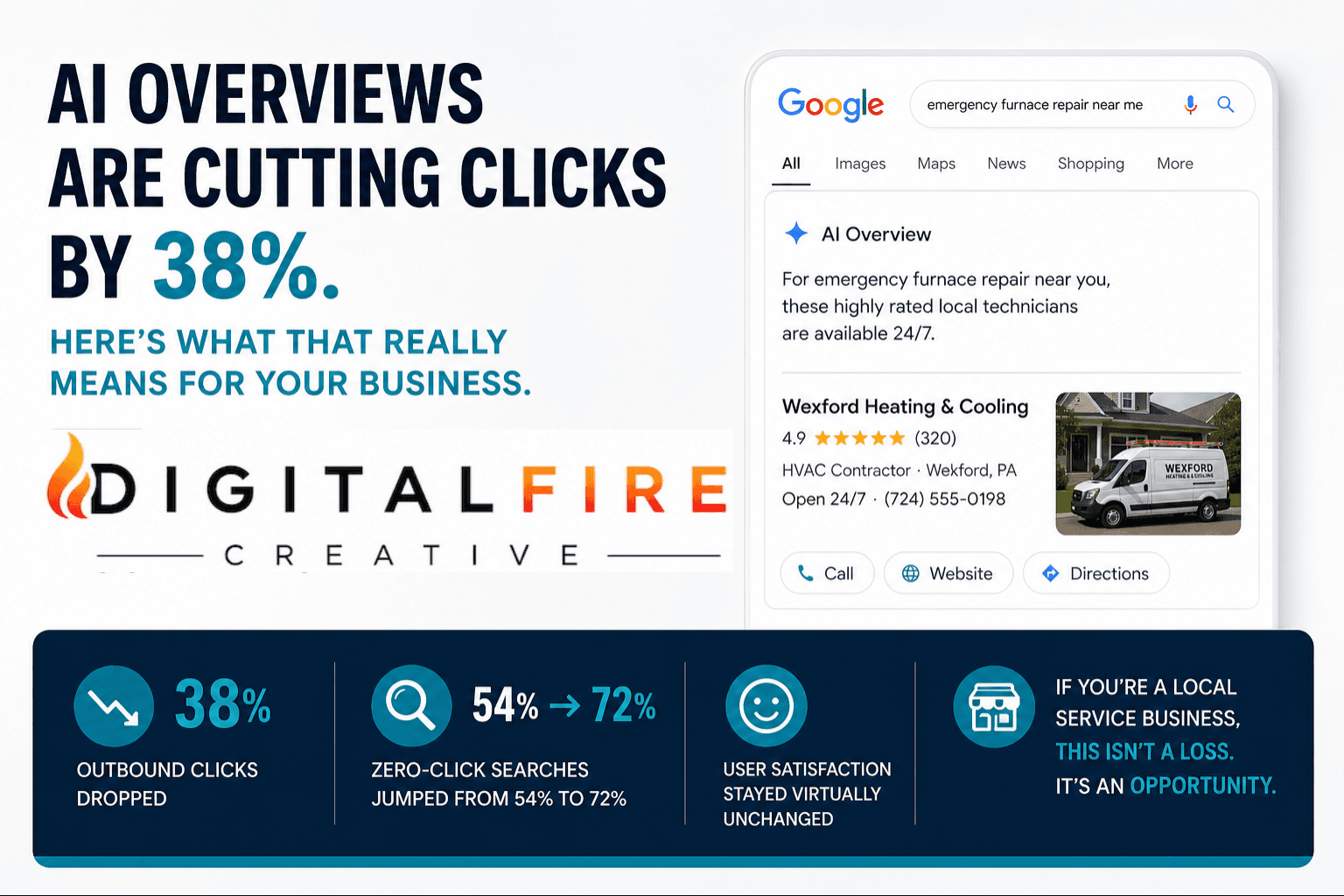
Why the 38% Drop in Google Clicks Is Good News for Local Service Businesses

Why Pittsburgh Businesses Should Choose an AI SEO Agency Over a Traditional SEO Company
Free Check
See how your business ranks in AI search
Get a free GEO report in 60 seconds, no card, no obligation. We will show you exactly where you stand and what your biggest opportunities are.
Get Your Free AI SEO Report →