What Is Generative Engine Optimization (GEO) and Why Pittsburgh Businesses Need to Know About It


If you have heard the term GEO and assumed it was just another name for local SEO, you are not alone. Most business owners in Pittsburgh and Pittsburgh North are hearing it for the first time and are not sure what separates it from the SEO they already know. The difference matters, and understanding it is becoming one of the more important things a local business owner can do in 2026.
What GEO Actually Stands For
GEO stands for Generative Engine Optimization. The generative part refers to generative AI, the technology behind tools like ChatGPT, Perplexity, Google AI Overviews, and Grok. These tools do not just return a list of links the way traditional search engines do. They generate a direct answer and, in many cases, recommend specific businesses by name.
Generative Engine Optimization is the practice of structuring your business's online presence so that those AI tools can find you, understand what you do, verify where you operate, and trust you enough to recommend you. It is a distinct discipline from traditional SEO, though the two share some foundations.
How GEO Differs From Traditional SEO
Traditional SEO is built around getting your website to rank on Google's results page. You optimize for keywords, build backlinks, improve page speed, and work to appear in the top ten results for searches relevant to your business. That still matters. It is not going away.
GEO operates on different logic. When someone asks ChatGPT to recommend a plumber in Cranberry Township, ChatGPT does not return a ranked list of links. It generates a direct answer. It might say something like "Based on available information, these businesses in Cranberry Township have strong reviews and are well established in the area." The businesses it names are not necessarily the ones ranking highest on Google. They are the ones whose online presence gave the AI enough structured, consistent, trustworthy information to make a confident recommendation.
That is the core of GEO. You are not optimizing for a ranking position. You are optimizing to be cited, recommended, and trusted by AI-generated answers.
What AI Engines Actually Look For
AI tools pull from multiple sources when forming a recommendation. Your website, your Google Business Profile, third-party directories like Yelp and Angi, your reviews and how you respond to them, and published content across the web all factor in. GEO is the process of making sure all of those sources are aligned, accurate, and rich enough for an AI engine to build confidence in your business.
Schema markup is structured data added to your website that tells AI engines exactly what your business is, what services you offer, where you operate, and how to contact you. Without it, AI engines have to guess. With it, they have a clear, machine-readable picture of your business.
Citation consistency means your business name, address, and phone number appear identically across every directory and listing on the web. Inconsistencies, even small ones like "Ave" vs "Avenue," create doubt for AI engines that are cross-referencing sources to verify your business is legitimate and local.
Review signals include not just the volume and rating of your reviews but the content inside them and how you reply. Location-specific language in reviews and replies builds geographic authority that AI engines can read and trust.
Authority content is published material, blog posts, FAQ pages, service pages, that demonstrates expertise in your field and your market. AI engines are more likely to recommend businesses whose online presence reflects genuine knowledge and local specificity.
Why Pittsburgh Businesses Are in a Good Position Right Now
GEO adoption in Pittsburgh and Pittsburgh North is still early. Most local businesses have not made any changes to optimize for AI search. That means the window for first-mover advantage is open. Businesses that build out their GEO signals now, before their competitors do, are establishing the kind of authority that compounds over time and becomes harder for late movers to close.
This is particularly true in specific verticals. Trades, medical offices, professional services, and restaurants across Cranberry Township, Wexford, McCandless, and the broader Pittsburgh North corridor are largely invisible in AI-generated recommendations right now. That is not because AI engines do not cover this market. It is because the businesses here have not given those engines enough to work with.
GEO and AI SEO Are Related But Not the Same Thing
You will hear both terms used in the market, sometimes interchangeably. GEO refers specifically to the practice of optimizing for AI-generated answers and recommendations. AI SEO is a broader term that encompasses both traditional search optimization and GEO, acknowledging that AI has changed how search engines themselves work, not just how separate AI tools operate.
At Digital Fire Creative, we use both terms because both are accurate depending on the context. The strategy we build for Pittsburgh businesses covers the full picture, traditional search foundations plus the GEO layer that is becoming increasingly critical as AI tools handle more and more of the discovery process.
Frequently Asked Questions
What does GEO stand for?
GEO stands for Generative Engine Optimization. It is the practice of optimizing your business's online presence to appear in AI-generated answers from tools like ChatGPT, Perplexity, and Google AI Overviews.
Is GEO the same as local SEO?
No. Local SEO focuses on ranking in traditional search engine results for location-based queries. GEO focuses on being recommended by AI-generated answers. The two share some foundations, citation consistency, Google Business Profile optimization, and reviews all matter for both, but GEO requires additional work around schema markup, structured content, and authority signals that traditional local SEO does not fully address.
Do Pittsburgh businesses actually need GEO right now?
Yes, and sooner is better than later. AI tools are already being used by local consumers to find and vet businesses in Pittsburgh and Pittsburgh North. The businesses that build GEO signals now are establishing authority ahead of the competition. Once a competitor is well established in AI recommendations, it becomes significantly harder and more expensive to displace them.
What does a GEO strategy include?
A complete GEO strategy covers schema markup on your website, citation cleanup and consistency across directories, Google Business Profile optimization, review strategy, and authority content. For Pittsburgh businesses, it also includes local signal building that ties your business specifically to the communities you serve, Cranberry Township, Wexford, McCandless, and surrounding areas.
How long does GEO take to show results?
Some GEO improvements, like citation fixes and schema markup, can show measurable results within 30 to 60 days. Building the kind of authority that consistently drives AI recommendations is a longer process, typically 90 days and beyond. The earlier you start, the stronger the compounding effect.
Want to Know Where You Stand?
Digital Fire Creative is a GEO agency based in Warrendale, serving independent businesses across Pittsburgh and Pittsburgh North. If you want to see exactly how AI engines currently see your business and where the gaps are, start with a free GEO check. It takes 60 seconds and gives you a clear picture of your current AI search visibility.
Keep Reading
More articles

5 Things Real Estate Agents in Cranberry Township and Wexford Can Do This Week to Show Up in AI Search
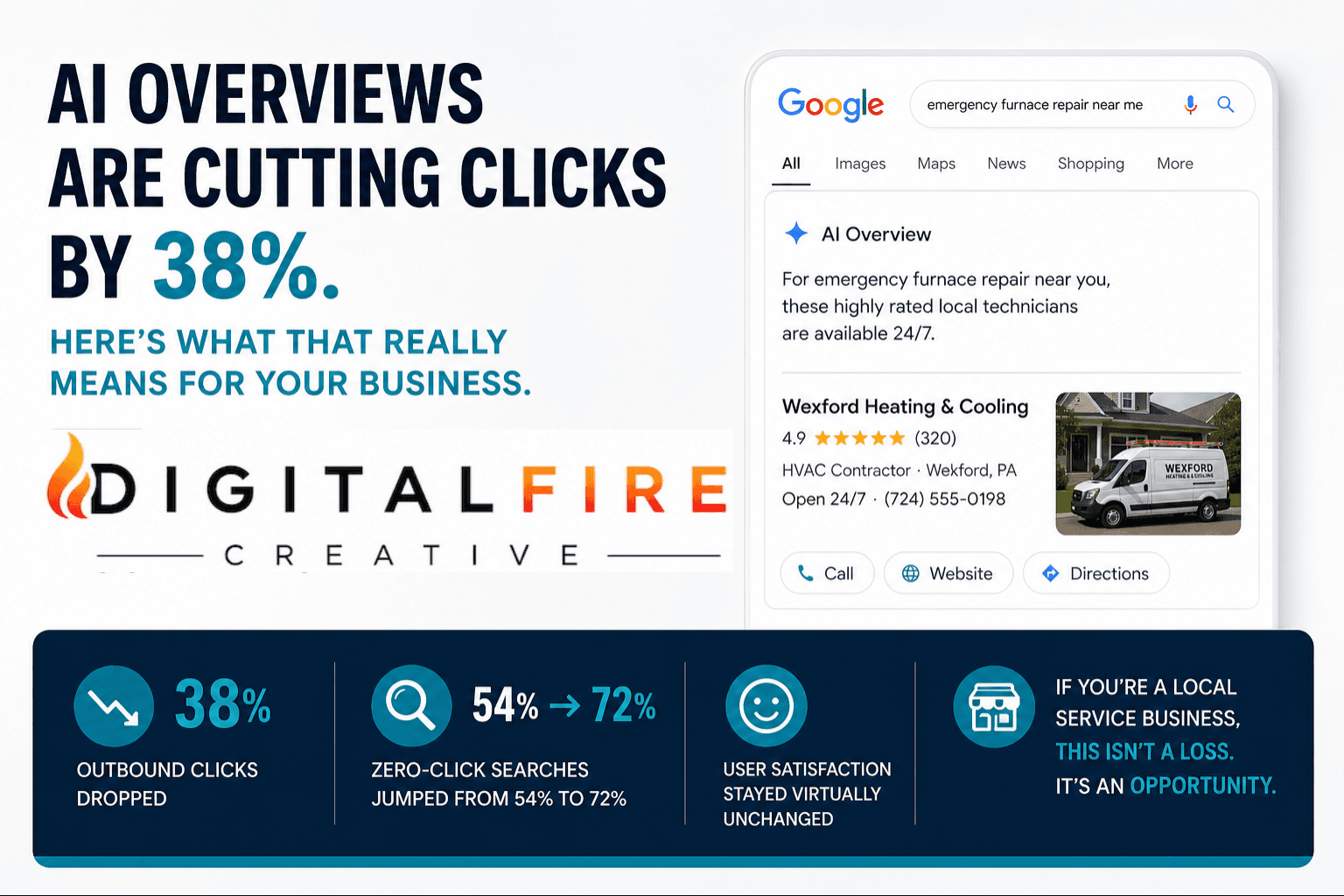
Why the 38% Drop in Google Clicks Is Good News for Local Service Businesses

Why Pittsburgh Businesses Should Choose an AI SEO Agency Over a Traditional SEO Company
Free Check
See how your business ranks in AI search
Get a free GEO report in 60 seconds, no card, no obligation. We will show you exactly where you stand and what your biggest opportunities are.
Get Your Free AI SEO Report →