What We Found When We Audited Pittsburgh Businesses for AI Search Visibility


Over the past year we've reviewed a lot of local business websites in Pittsburgh North. Restaurants in Cranberry Township. Service contractors in Wexford. Retailers in Mars and Allison Park. Professional services firms across Butler and Allegheny Counties. The businesses are different, but the problems we find are almost always the same.
What follows is a summary of the most common gaps we see when auditing local businesses for AI search visibility. If you own or run a business in this area, there's a reasonable chance you have at least two or three of these. Most businesses we look at have all of them.
Gap One: No Schema Markup Anywhere on the Site
This is the most common finding, and in many ways the most consequential. Schema markup is structured code that tells AI engines exactly what your business is, where it operates, what it offers, and who it serves. Without it, an AI trying to understand your business has to piece together information from your regular page content, which is slower, less reliable, and less likely to produce a confident recommendation.
The vast majority of websites built on standard platforms like Wix, Squarespace, or basic WordPress themes don't include LocalBusiness schema by default. It has to be added deliberately. Most agencies and freelancers don't add it unless you specifically ask, and most business owners don't know to ask.
For a business in Cranberry Township, proper schema markup would declare your business name, your address with the correct zip code (16066 for most of Cranberry), your phone number, your service area, your hours, and the specific services you offer. Each piece of information is labeled and structured so an AI engine doesn't have to guess.
Gap Two: Citation Inconsistencies Across Directories
Almost every business we audit has this problem to some degree. Your business name, address, and phone number appear in slightly different formats across different listing sites, and those inconsistencies quietly undermine your AI search credibility.
We've seen Cranberry Township businesses listed as "Cranberry Twp," "Cranberry Township," and "Cranberry" across different directories, sometimes all three within the same business's listings. We've seen phone numbers with different area codes for the same business because ownership changed years ago and the old number never got cleaned up. We've seen addresses with suite numbers on some listings and not others.
None of these feel like serious problems on their own. But taken together they create a picture of a business whose information isn't fully reliable, and AI engines respond to that by being less willing to recommend you.
Gap Three: Service Pages That Don't Answer Real Questions
Most service pages are written as a pitch rather than as a resource. They explain what the business does in broad terms, highlight a few differentiators, and end with a contact form. That's fine for a human who's already somewhat interested and just needs a nudge. It's not enough for an AI engine trying to determine whether this business is a good match for a specific query.
When someone asks ChatGPT "who does kitchen remodeling in Wexford PA," the AI is looking for a business whose website explicitly and clearly answers that question. A page that talks about "transforming spaces with quality craftsmanship" doesn't answer it. A page with a section that says "We provide full kitchen remodeling services to homeowners in Wexford, Cranberry Township, and surrounding areas in Pittsburgh North" does.
The fix here isn't to rewrite your entire website. It's usually a matter of adding a few specific sentences to existing pages, building out proper FAQ sections, and making sure your location and service area are stated clearly rather than implied.
Gap Four: A Google Business Profile That's Technically Active but Practically Dormant
Having a claimed Google Business Profile is the baseline. What actually matters for AI search is whether that profile looks like it belongs to a business that's actively operating and engaged with its customers.
A profile with the last post from eighteen months ago, three photos, and reviews that stopped coming in a year back sends a signal to AI engines that the business may have wound down or changed significantly. It's not that AI engines penalize you for an inactive profile exactly. It's more that active, well-maintained profiles are much more likely to be flagged as credible and current.
For businesses in Pittsburgh North, keeping a profile active is genuinely straightforward. A short post once a week, a few new photos every month, a response to each review as it comes in. It doesn't require much time, but the cumulative effect over several months is significant.
Gap Five: No Local Content That Establishes Area Authority
The businesses that show up most consistently in AI search results for local queries tend to have content on their websites that's genuinely specific to their area. Not just a mention of Cranberry Township in the footer. Actual content that demonstrates knowledge of the local market and the communities they serve.
A blog post about serving businesses in Pittsburgh North. A service page that mentions the specific zip codes covered. An about page that references the local area by name more than once. These signals help AI engines build a confident picture of your business as a genuine local presence rather than a generic operation that happens to have a local address.
What to Do With This Information
If you're reading this and recognizing your own business in two or three of these gaps, that's actually a good position to be in. These are known, solvable problems. The businesses that fix them first in any given market tend to establish a meaningful lead in AI search visibility that takes competitors a long time to close.
The first step is understanding exactly where you stand. Our free GEO report looks at your AI search visibility across several of these categories and gives you a clear, specific picture of where your biggest opportunities are. It takes about 60 seconds to generate. If you want to know what an AI audit of your business would actually find, that's the fastest way to get the answer.
Keep Reading
More articles

5 Things Real Estate Agents in Cranberry Township and Wexford Can Do This Week to Show Up in AI Search
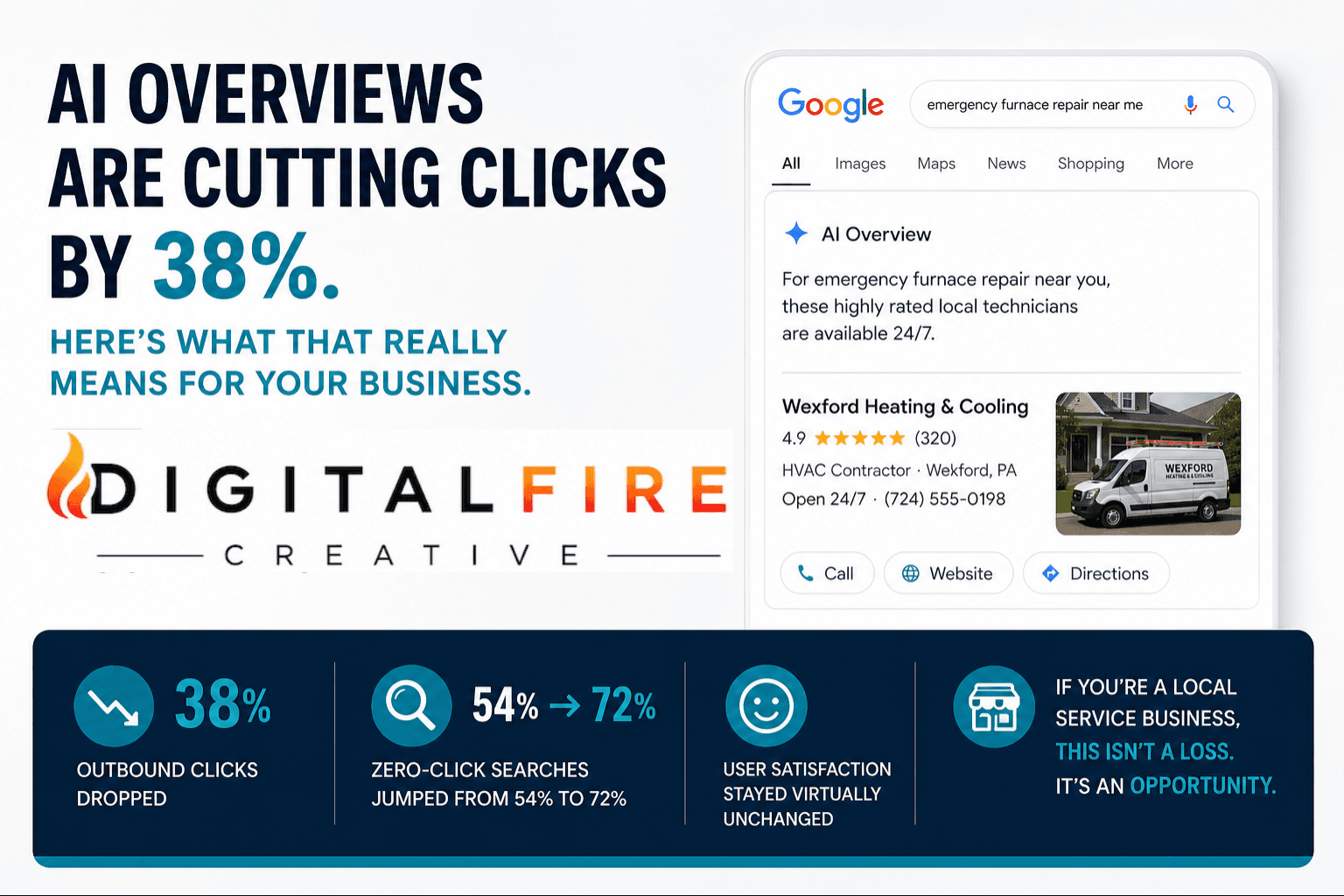
Why the 38% Drop in Google Clicks Is Good News for Local Service Businesses
Why Pittsburgh Businesses Should Choose an AI SEO Agency Over a Traditional SEO Company
Free Check
See how your business ranks in AI search
Get a free GEO report in 60 seconds, no card, no obligation. We will show you exactly where you stand and what your biggest opportunities are.
Get Your Free AI SEO Report →