AI Is Already Recommending Independent Businesses in Pittsburgh. Here's Why Some Show Up and Others Don't.


There's a common assumption among local business owners that AI search is dominated by national chains and big brands. That the little guy doesn't stand a chance against a company with a corporate marketing team behind it. In my experience looking at AI search results across Pittsburgh North, that assumption is wrong. Independent businesses show up regularly. The ones that don't aren't being blocked by anything. They're just missing a few specific things that the ones showing up have figured out.
Understanding what separates those two groups is probably the most useful thing a local business owner can know right now.
AI Engines Want to Recommend Local Businesses
When someone asks ChatGPT for a restaurant in McCandless or a contractor in Cranberry Township, the AI isn't looking to push a national brand. It's looking for the best answer to a local question. Local specificity is actually an advantage in AI search, not a liability. An independent business that is genuinely rooted in a community, with real customer reviews, a clear service area, and specific knowledge of the local market, is exactly what AI engines are trying to find.
The problem isn't that AI engines are biased against independent businesses. The problem is that most independent businesses haven't given AI engines enough clear, consistent, structured information to work with. The AI wants to recommend them. It just can't find what it needs to do it confidently.
What the Businesses That Show Up Have in Common
When I look at the independent businesses that consistently appear in AI recommendations for Pittsburgh North searches, a few things come up every time. None of them are complicated. All of them are buildable.
Their information is consistent across every platform.
Name, address, and phone number are identical across Google, Yelp, Facebook, Bing, Apple Maps, and every directory where they appear. No variations in how the address is written. No old phone numbers sitting on platforms they forgot about. This consistency tells AI engines that the information is reliable and worth acting on. Inconsistency does the opposite.
They show up on the platforms AI engines pull from directly.
This is worth saying clearly: Yelp, Angi, BBB, and Nextdoor aren't just citation sources. ChatGPT has stated directly that it draws from Yelp, Angi, and BBB when forming local business recommendations. Nextdoor is increasingly referenced for neighborhood-level searches. A business with an active, well-reviewed presence on those platforms isn't just building citation consistency. It's appearing in the actual sources AI engines cite when they form an answer. The businesses showing up in Pittsburgh North AI results tend to have real review activity on at least two or three of these platforms, not just a claimed listing that hasn't been touched in years.
Their website answers specific questions directly.
The businesses showing up in AI results tend to have websites that answer the actual questions people ask AI engines. Not vague marketing copy about quality and service. Specific answers to specific questions. Do you serve Cranberry Township? What are your hours? Do you handle emergency calls? What neighborhoods do you cover? AI engines are looking for those answers when forming a recommendation. A website that provides them clearly gets cited. One that doesn't gets passed over.
Their Google Business Profile is active and complete.
The independent businesses appearing in AI recommendations almost always have Google Business Profiles that look alive. Recent posts. Current photos. Responses to reviews. Complete service listings. A profile that was set up two years ago and hasn't been touched since sends a very different signal than one that shows regular activity. AI engines use that activity as a proxy for whether the business is currently operating and engaged.
They have schema markup on their website.
This is the most technical item on the list and the one most business owners have never heard of. Schema markup is structured code that labels your business information in a format AI engines can read directly. Without it, AI has to extract information from your page content by guessing at context. With it, the AI has a clearly labeled file that says: this is the business name, this is the address, this is what they offer, this is where they operate. That clarity translates directly into more confident recommendations.
What the Businesses That Don't Show Up Are Missing
It's rarely one big thing. It's almost always a combination of smaller gaps that add up to enough uncertainty that the AI passes on making a recommendation.
A business might have a solid Google Business Profile but a website with no schema markup and no FAQ content. The AI can see they exist but can't extract enough specifics to confidently recommend them for a particular query. Another business might have good website content but scattered, inconsistent directory listings that create conflicting information about their address or phone number. The AI finds the conflict and defaults to businesses whose information is cleaner.
In Pittsburgh North specifically, the most common gaps I see are citation inconsistencies across directories, missing or incomplete schema markup, and service pages written for humans browsing a website rather than for AI engines extracting facts. Fix those three things and most businesses move from invisible to visible in AI search within 60 to 90 days.
The Local Advantage Is Real
Here's the thing that gets overlooked in conversations about AI search and local business. National chains have scale and budget, but they don't have local depth. A chain location in Cranberry Township is managed centrally, its content is largely identical to every other location in the country, and it has no genuine connection to the specific community it's in.
An independent business in Cranberry Township has been serving that specific community, knows its customers by name, understands the local market, and has reviews from real neighbors. That local specificity, when it's structured correctly, is exactly what AI engines prioritize for local searches. It's an advantage that a national chain can't manufacture, no matter how large its marketing budget is.
The independent businesses already showing up in Pittsburgh North AI search results have figured out how to make that local depth legible to AI engines. The ones that aren't showing up have the same depth. They just haven't built the infrastructure around it yet.
The Businesses That Act Now Build an Advantage That Compounds
AI engines build confidence in businesses over time. A business that establishes consistent, clear AI visibility in Cranberry Township today is significantly harder to displace six months from now than it was to appear in the first place. The businesses already showing up in local AI recommendations have a head start, but it's not an insurmountable one.
Most independent businesses in Pittsburgh North haven't started this work yet. That's the opportunity. The question is whether you act on it before a competitor in your category does.
Our free GEO report shows you exactly where you stand in AI search right now, specifically what's missing, and what would have the biggest impact on your visibility. It takes 60 seconds to generate and doesn't require a credit card. If you're curious whether your business is showing up when locals ask AI for a recommendation in your area, that's the fastest way to find out.
Keep Reading
More articles

5 Things Real Estate Agents in Cranberry Township and Wexford Can Do This Week to Show Up in AI Search
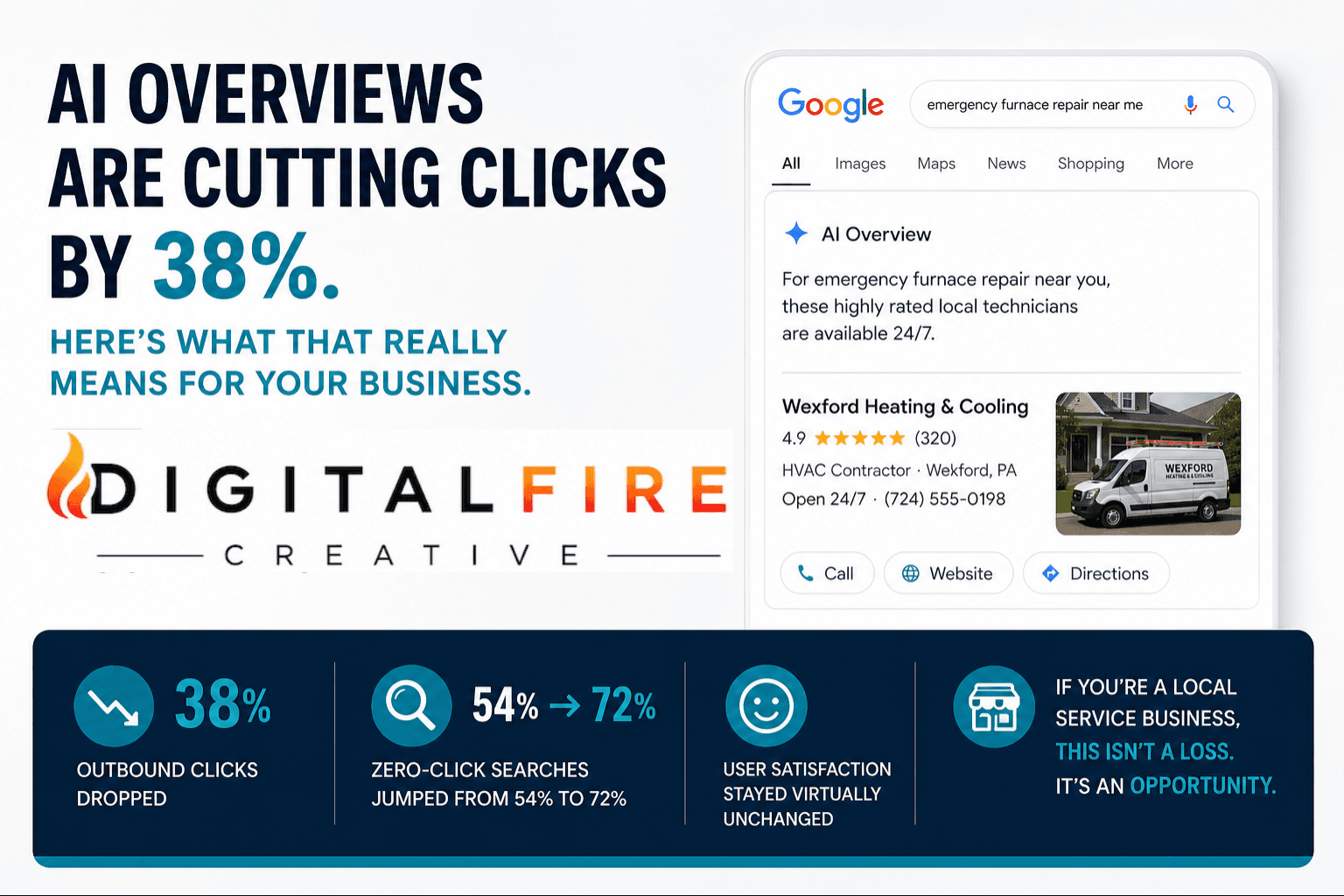
Why the 38% Drop in Google Clicks Is Good News for Local Service Businesses

Why Pittsburgh Businesses Should Choose an AI SEO Agency Over a Traditional SEO Company
Free Check
See how your business ranks in AI search
Get a free GEO report in 60 seconds, no card, no obligation. We will show you exactly where you stand and what your biggest opportunities are.
Get Your Free AI SEO Report →