Why Pittsburgh Area Attorneys Are Not Showing Up in AI Answers

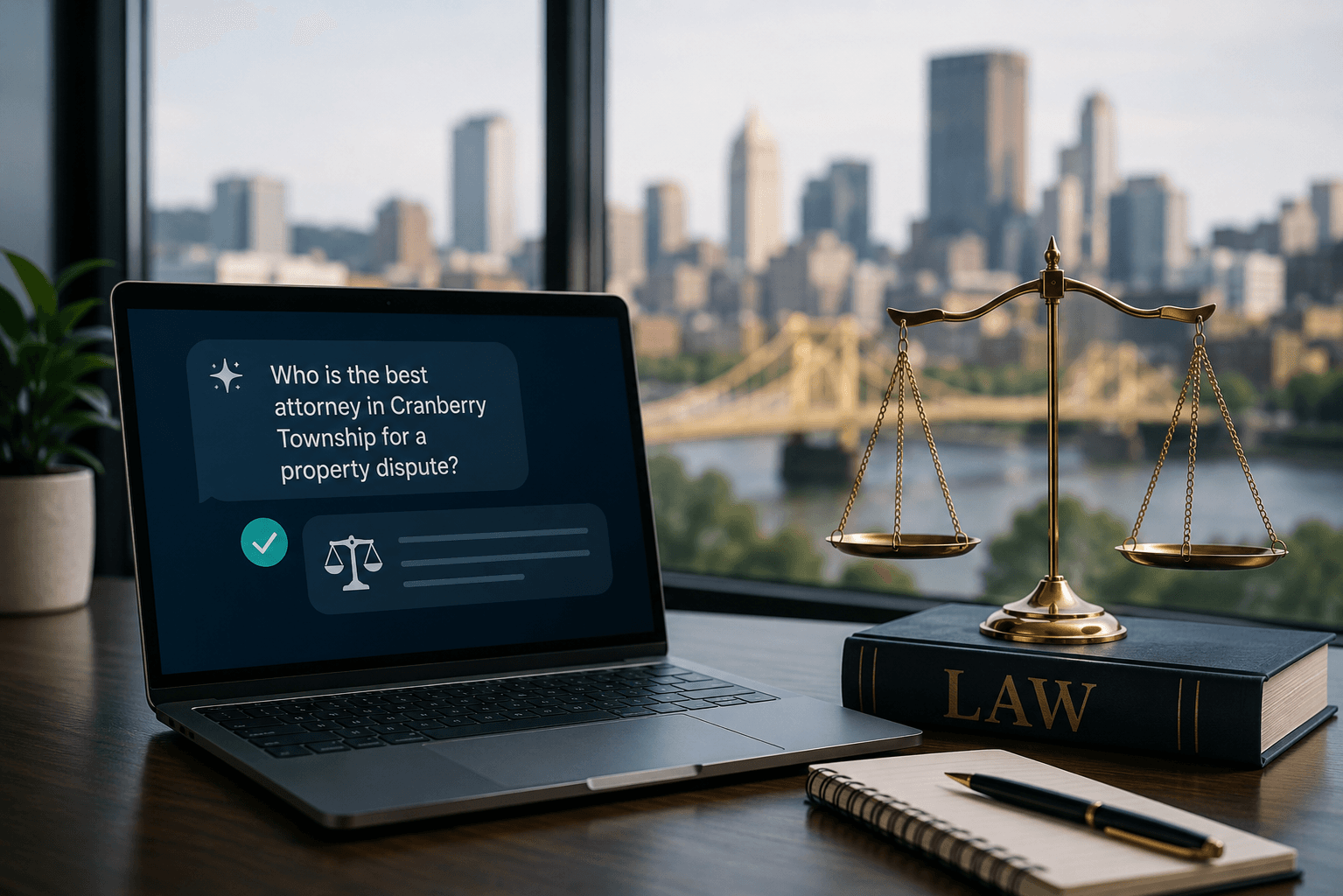
If you have searched for your own law firm in ChatGPT or asked Google a question about finding an attorney in Cranberry Township, you may have noticed something uncomfortable. Some firms show up in the answer. Others do not exist in it at all. The difference is not about who has the bigger ad budget. It is about something more fundamental than that.
AI-generated answers are now a real part of how people find professional services. A homeowner in Wexford dealing with a property dispute, a business owner in McCandless looking for a contract attorney, a family in Hampton Township navigating an estate question -- these people are increasingly getting their first recommendation not from a Google results page but from an AI engine that synthesizes information and names a specific firm.
If your firm is not in that answer, you are not losing a click. You are losing the conversation entirely.
The Gap Is Not Technical. It Is a Trust Gap.
There is a temptation to treat AI search visibility as a technical problem. Schema tags, structured data, citation graphs -- these things matter and they are part of the work. But they are not the reason some Pittsburgh area attorneys show up in AI answers and others do not.
Eric Downing, founder of Digital Fire Creative, put it this way in a piece published this week on his his personal site:
The gap between businesses that are cited in AI answers and businesses that are not is not primarily a technical gap. It is a trust gap. AI engines are trying to answer questions the way a knowledgeable, well-connected person would answer them. They pull from sources that have demonstrated consistent expertise, local relevance, and a track record of being useful. That is not a technical profile. That is a reputation.
That framing matters for attorneys specifically. A law firm's reputation has always been built on expertise, consistency, and community presence. Those are exactly the signals AI engines are evaluating. The problem is that most law firms have never translated that reputation into the kind of digital presence an AI engine can read and recognize.
What AI Engines Are Actually Looking For
When someone in Allison Park asks an AI engine to recommend a family law attorney nearby, the engine is not running a paid ad auction. It is pulling from everything it has learned about which firms have demonstrated clear, consistent authority in a specific practice area for a specific geography.
That means a few things need to be true about your firm's online presence:
Your practice areas need to be described clearly and consistently across your website, your directory listings, and any third party sources that mention your firm. Vague language like "full service legal representation" does not help an AI engine understand what questions you are the right answer to.
Your geography needs to be explicit. If you serve clients in Wexford, Mars, and Warrendale, that needs to appear in your content in a way that connects your firm to those communities specifically. A general Pittsburgh reference is not enough when a potential client is asking about attorneys near them.
Your firm needs a track record of being cited as useful. This includes third party mentions, local directory presence, community involvement that has been written about, and content that answers the actual questions your potential clients are asking before they ever contact you.
Why This Is Harder for Attorneys Than It Looks
Most law firm websites are built for two audiences: existing clients looking for contact information and search engines looking for keywords. Neither of those audiences is an AI engine trying to determine whether your firm is the most trustworthy answer to a specific question from a specific type of person in a specific part of the Pittsburgh area.
The content that exists on most firm websites is credential-forward. Bar admissions, years of experience, case results where permitted. That content is important but it does not answer the questions potential clients are actually asking. It does not build the kind of recognizable, human-centered authority that AI engines are now using as their primary signal.
Attorneys who are showing up consistently in AI-generated answers have, in most cases, built a body of content that answers real questions from real people in plain language. They have established clear geographic relevance. They have a consistent presence across the sources AI engines use to evaluate credibility.
Most firms in the Pittsburgh area have not done that work yet. That is a gap, but it is also an opening.
What You Can Do About It
The starting point is understanding where you actually stand. Before you can close a trust gap, you need to know how wide it is. That means auditing your current AI discoverability -- how your firm shows up when someone asks an AI engine the questions your potential clients are asking right now.
Some attorneys manage this work themselves once they understand the framework. Others work with a specialist to build and maintain the kind of presence that compounds over time. Either way, the first step is the same: know what the AI engines currently see when they look at your firm.
You can start with a free audit at Digital Fire Creative's gseo-check tool. It gives you a baseline picture of where your firm stands in AI search visibility so you know what you are actually working with before you decide how to address it.
If you want a deeper understanding of how AI discoverability works for local businesses and professional service firms, The Business Owner's Guide to AI SEO by Eric Downing, founder of Digital Fire Creative, is available on Amazon and covers the full framework in plain language.
The attorneys showing up in AI answers right now are not there by accident. They built something that looks trustworthy to an AI engine because it is trustworthy to the people it was built for. That work is replicable. It builds over time. And in the Pittsburgh area, most of your competitors have not started it yet.

Free Check
See how your business ranks in AI search
Get a free GEO report in 60 seconds, no card, no obligation. We will show you exactly where you stand and what your biggest opportunities are.
Get Your Free AI SEO Report →