Why Your Business Isn't Showing Up When Someone Asks ChatGPT for a Recommendation


Not long ago I was sitting across from a business owner in Cranberry Township who had been running his HVAC company for eleven years. Good reviews. Solid reputation. Word of mouth had kept him busy for most of that time. But he had noticed something over the past year. The phone was ringing a little less. Not dramatically. Just less.
We opened up ChatGPT together and typed: "Who is a good HVAC company near Cranberry Township PA?" Three names came up. His wasn't one of them.
That conversation is what started a lot of the work we do now.
Something Shifted in How People Find Local Businesses
It didn't happen overnight, but it happened fast. People used to Google something, get a list of ten blue links, and scroll around until they found what they were looking for. That behavior is changing. A growing number of people now just ask ChatGPT, Perplexity, or Google's AI overview directly. They want one answer, not ten options.
For local businesses, that shift matters a lot. When Google gives you ten results, you might be number seven and still get the click. When ChatGPT gives one or two recommendations, you either make the cut or you don't. There's no page two.
The businesses that tend to show up aren't necessarily the best at their craft. They're the ones whose online presence is structured in a way that AI engines can read, trust, and recommend with confidence. That's a meaningfully different thing from traditional SEO, and most local businesses haven't made the adjustment yet.
How AI Engines Actually Decide Who to Recommend
It's worth understanding what's happening when ChatGPT answers a local search query. These models are trained on enormous amounts of text from across the web. They've absorbed reviews, directory listings, local news mentions, blog posts, schema markup, and business profiles. When someone asks for a recommendation, the AI draws on all of that to figure out which businesses seem credible, well-established, and relevant to the request.
A few factors come up consistently when we look at which local businesses appear in AI recommendations.
Consistency across the web.
If your business name, address, and phone number appear in different formats across different directories, AI engines don't fully trust the information. Something as simple as "St." versus "Street" in your address can create enough noise to reduce confidence. It seems minor, but at scale these inconsistencies signal that the data around your business isn't reliable.
Structured, specific content.
AI engines are much better at recommending businesses that explain clearly what they do, who they serve, and where they operate. Not buried in a wall of text, but organized in a way that's easy to extract. FAQ sections are particularly useful here. A page that directly answers "Do you offer same-day service in Wexford?" is far more likely to be cited than a page that says "We're here to help with all your needs." The first one gives the AI something concrete to work with. The second one doesn't.
Authority signals from multiple sources.
Reviews matter, but not in quite the same way they do for traditional rankings. What carries more weight is whether your business is mentioned across multiple credible sources in a consistent and positive way. Local news coverage, industry directory listings, chamber of commerce memberships, detailed Google Business Profile entries all contribute to how an AI engine perceives your business as a real, trustworthy entity in your area.
Why Most Local Businesses Are Missing These Signals
The businesses I work with in Pittsburgh North are usually doing reasonably well on traditional Google search. They have decent websites. Some of them rank well for certain keywords. But when we look at their AI visibility specifically, the gaps are almost always the same ones.
Schema markup is usually missing entirely. This is the structured code that tells search engines exactly what your business is, what it offers, where it's located, and what its hours are. It's been important for traditional SEO for years, but for AI search it has become significantly more critical. Most website builders don't add it by default, and most business owners don't know to ask for it.
FAQ content is either absent or too generic to be useful. The questions people actually ask about your business are usually not the ones on your website. Real questions like "Do you work in Mars PA?" or "How quickly can you get someone out?" are the kinds of things AI engines look for when deciding if you're a good match for a specific query. A website that doesn't answer those questions clearly is leaving AI visibility on the table.
Google Business Profiles are often incomplete or sitting dormant. Regular posts, updated service descriptions, answered questions in the Q&A section, and a steady flow of recent reviews all help. Not because Google directly feeds ChatGPT, but because a well-maintained and active profile is one of the clearest signals that a business is legitimate, current, and worth recommending.
What the Fix Actually Looks Like
The good news is that most of these issues are fixable. They're not complicated, but they do require knowing what to look for and being methodical about it.
For the HVAC business owner I mentioned, we started with a citation audit across the major directories. There were seven different variations of his business name across about thirty listings. We standardized those. Then we added LocalBusiness and Service schema markup to his website. We rewrote his service pages to include direct, specific answers to the questions his customers actually ask. And we built out a proper FAQ section with location-specific content targeting Cranberry Township, Wexford, and the other communities he actually serves.
Within about six weeks, his business started appearing in ChatGPT results for relevant local queries. Not every query. But the ones that matter most to someone looking for HVAC help in his area.
That's what GEO looks like in practice. It's not magic and it doesn't happen overnight. But it's also not as complicated as it might sound. Most of the work is about giving AI engines clear, consistent, trustworthy information to act on. Once you do that, the recommendations tend to follow.
What You Can Do Right Now
If you want a quick sense of where your business stands, open ChatGPT and type a few queries someone in your area might realistically use to find you. "Best [your service] in [your town]" is a good starting point. See what comes up. See if you're there.
If you're not, that's useful information. It tells you there's a gap between how your business exists in the real world and how it's represented in the data that AI engines pull from. That gap is closeable.
We offer a free GEO report that looks at your AI visibility across several categories and gives you a clear picture of where the biggest opportunities are. It takes about 60 seconds to run and doesn't require a credit card. If you're curious about where you stand, that's the easiest place to start.
Keep Reading
More articles

5 Things Real Estate Agents in Cranberry Township and Wexford Can Do This Week to Show Up in AI Search
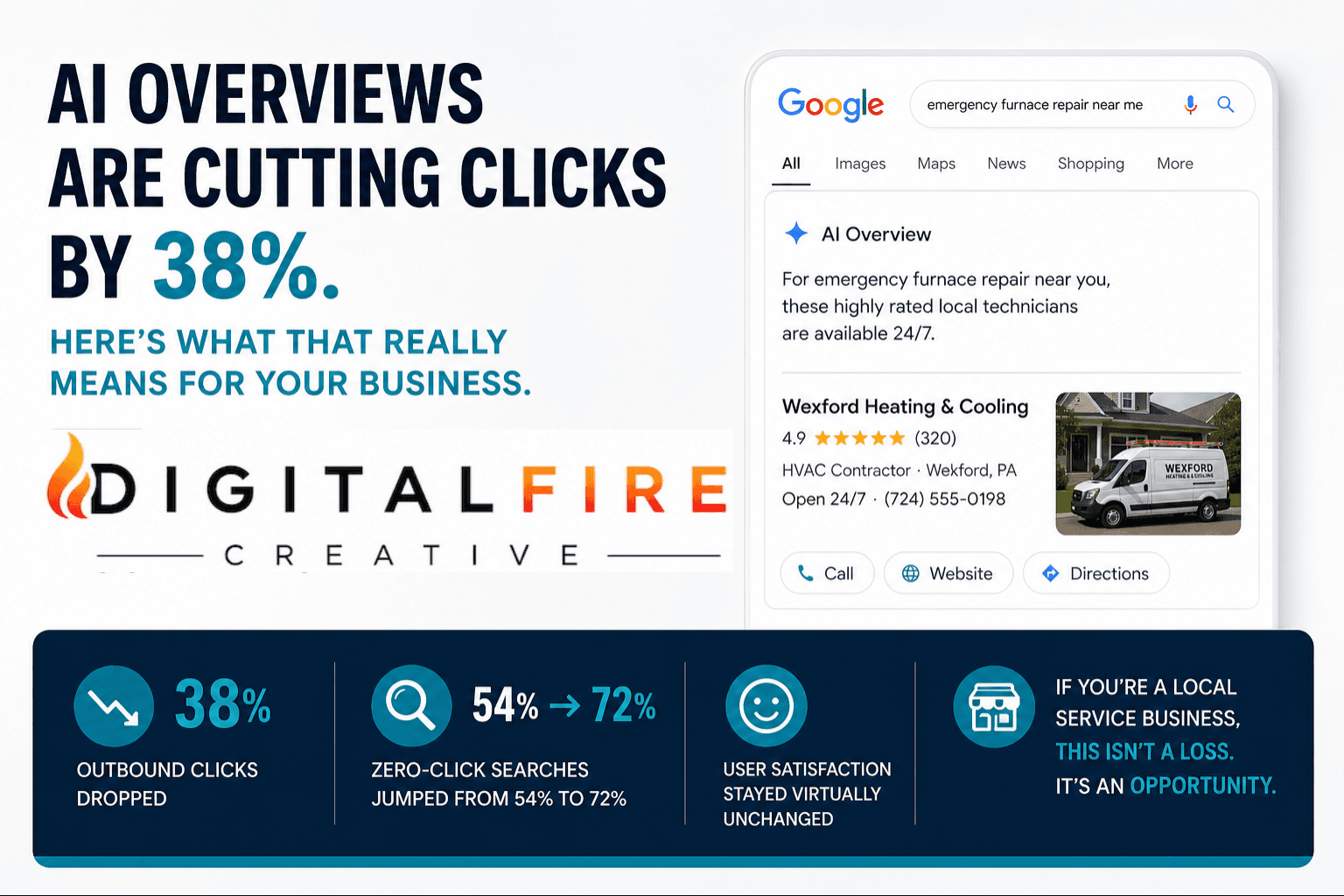
Why the 38% Drop in Google Clicks Is Good News for Local Service Businesses

Why Pittsburgh Businesses Should Choose an AI SEO Agency Over a Traditional SEO Company
Free Check
See how your business ranks in AI search
Get a free GEO report in 60 seconds, no card, no obligation. We will show you exactly where you stand and what your biggest opportunities are.
Get Your Free AI SEO Report →